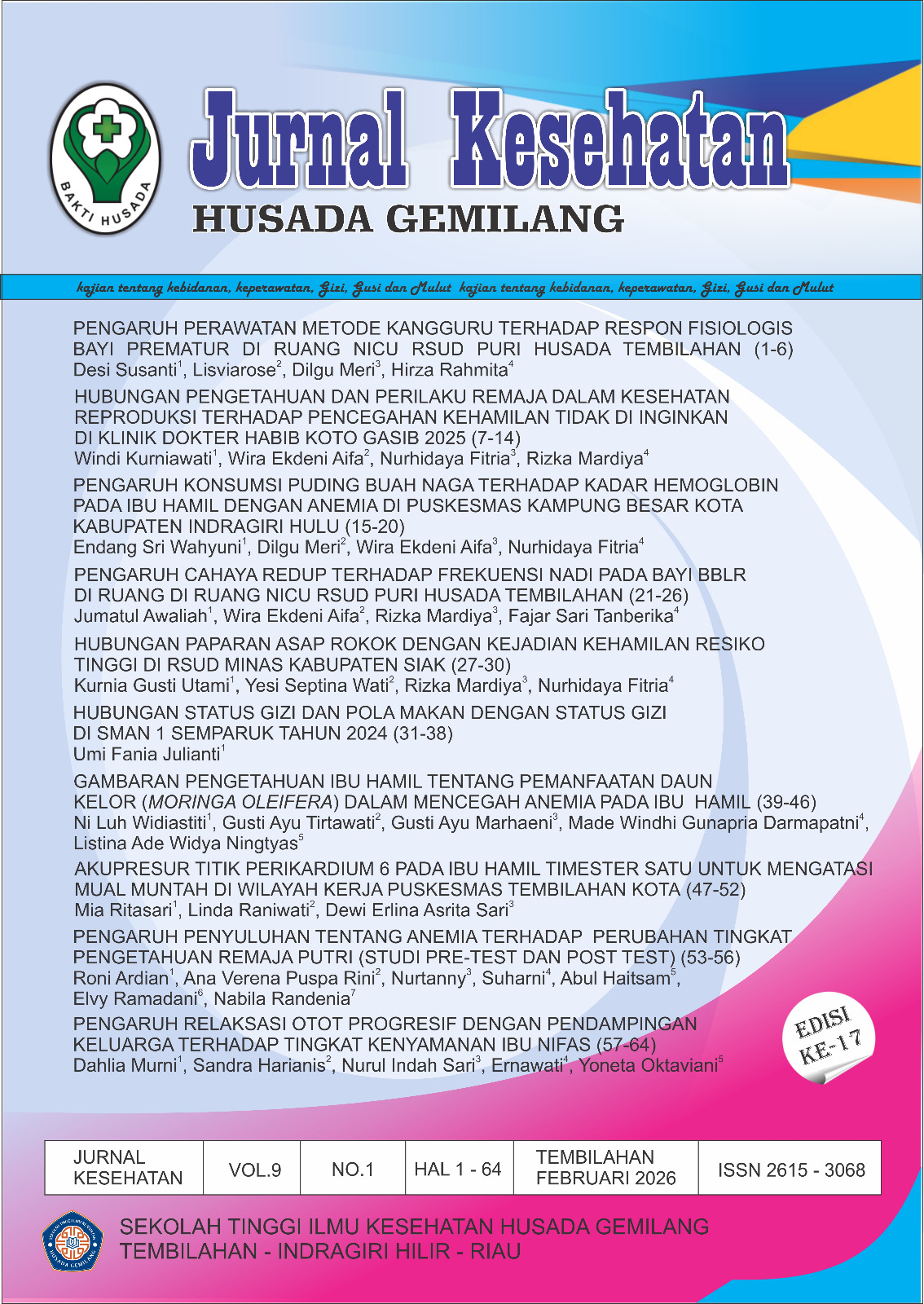
PENGARUH CAHAYA REDUP TERHADAP FREKUENSI NADI PADA BAYI BBLR DI RUANG NICU RSUD PURI HUSADA TEMBILAHAN
DOI:
https://doi.org/10.61129/jkhg.v9i1.150Kata Kunci:
Baby; Low birth weight; Pulse frequency; Dim lightAbstrak
Bayi BBLR mengalami masalah karena imaturitas organ tubuhnya, kondisi lingkungan luar rahim yang berbeda dengan kondisi rahim menimbulkan stress sehingga berdampak pada kondisi fisiologisnya. Tujuan Penelitian ini untuk mengetahui pengaruh pemberian cahaya redup terhadap frekuensi nadi pada bayi BBLR di Ruang NICU Rumah Sakit Umum Daerah Puri Husada Tembilahan Tahun 2025 Metode Penelitian ini Menggunakan pre experimental design dengan rancangan pre-test and post- test without control. Pengambilan sampe menggunakan rumus Slovin dengan tingkat signifikansi 5%, sehingga diperoleh 29 responden. Diberikan terapi cahaya redup intensitas cahaya <50 lux Uji statistik dengan Wilcoxon test. Berdaasrkan Hasil dari penelitian ini bahwa nilai P value < α ( 0,05) yaitu 0,000 pada tingkat kepercayaan 95%, usia bayi paling banyak 10 hari dan 15 hari. Rata-rata frekuensi nadi sebelum terapi cahaya redup 167.69 dan rata- rata fekuensi nadi sesudah terapi cahaya redup 138.52. Kesimpulan Terdapat pengaruh pemberian cahaya redup terhadap frekuensi nadi BBLR di Ruang NICU Rumah Sakit Umum Daerah Puri Husada Tembilahan Tahun 2025 dengan P value 0,000. Sehingga cahaya redup dapat dipakai sebagai terapi
Low Birth Weight (LBW) infants experience problems due to the immaturity of their organs. The external environment outside the womb, which differs from the conditions in the womb, causes stress that impacts their physiological condition. The purpose of this study is to determine the effect of dim light administration on the heart rate of LBW infants in the NICU Room of Puri Husada Tembilahan Regional General Hospital in 2025. This study uses a pre-experimental design with a pre-test and post-test without control. Sampling was carried out using Slovin's formula with a significance level of 5%, resulting in 29 respondents. They were given dim light therapy with an intensity of <50 lux. Statistical analysis was performed using the Wilcoxon test. Based on the results of this study, the P value < α (0.05), which is 0.000, at a 95% confidence level. The age of the infants was mostly 10 days and 15 days. The average pulse frequency before dim light therapy was 167.69, and the average pulse frequency after dim light therapy was 138.52. Conclusion: There is an effect of dim light therapy on the pulse frequency of low birth weight infants (LBW) in the NICU of Puri Husada Regional General Hospital in Tembilahan in 2025, with a P value of 0.000. Therefore, dim light can be used as a complementary therapy in midwifery practice in the NICU of Puri Husada Regional General Hospital in Tembilahan.
Unduhan
Unduhan
Diterbitkan
Cara Mengutip
Terbitan
Bagian
Lisensi
Hak Cipta (c) 2026 Jumatul Awaliah, Wira Ekdeni Aifa, Rizka Mardiya, Fajar Sari Tanberika

Artikel ini berlisensiCreative Commons Attribution-ShareAlike 4.0 International License.