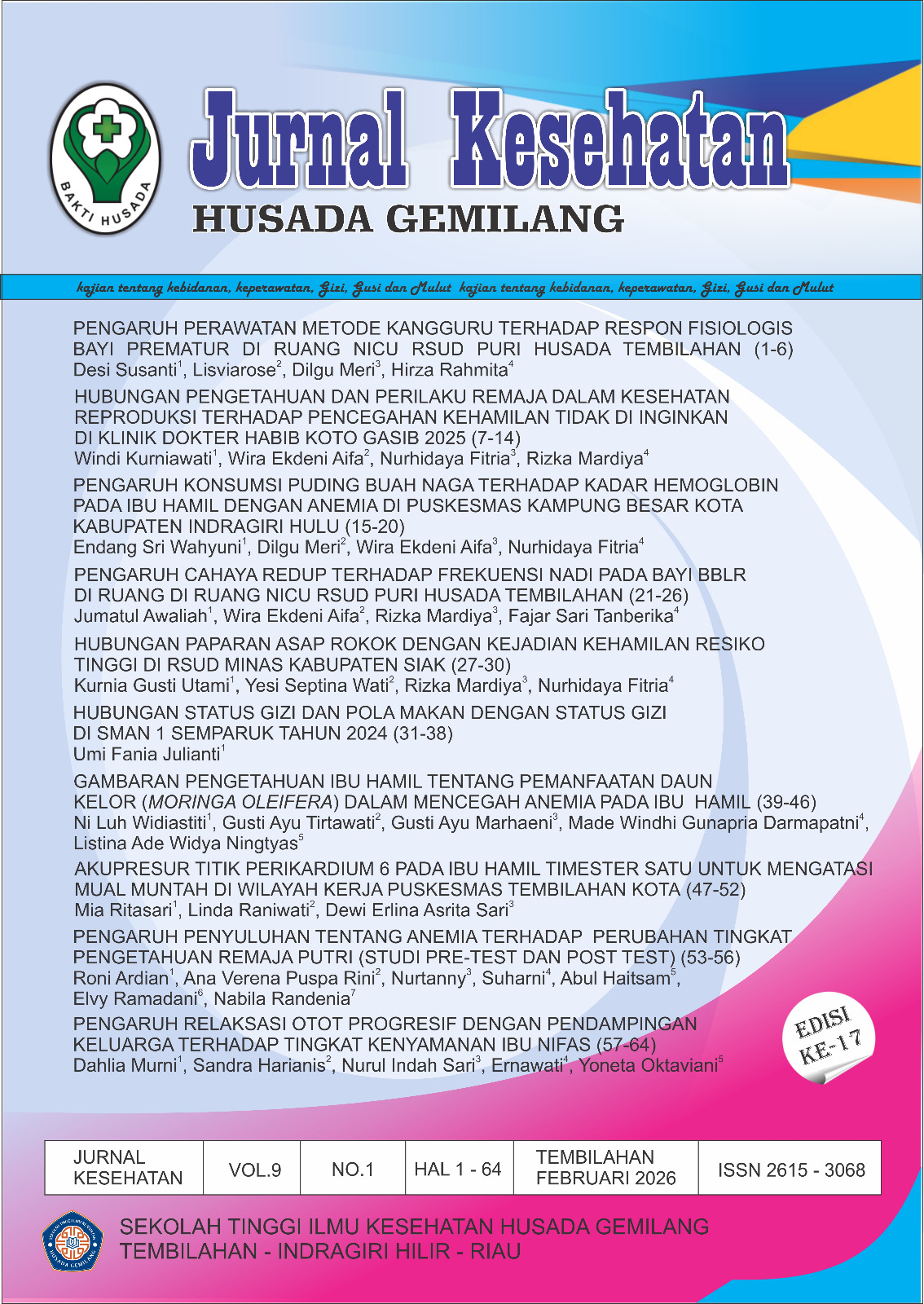
PENGARUH PERAWATAN METODE KANGGURU TERHADAP RESPON FISIOLOGIS BAYI PREMATUR DI RUANG NICU RSUD PURI HUSADA TEMBILAHAN
DOI:
https://doi.org/10.61129/jkhg.v9i1.149Kata Kunci:
Premature babies; Kangaroo care method; Baby physiologyAbstrak
Bayi prematur adalah bayi yang lahir dengan usia kehamilan kurang dari 37 minggu dan
berisiko tinggi mengalami ketidakstabilan fisiologis seperti gangguan pengaturan suhu tubuh, ketidakstabilan denyut jantung, pernapasan yang tidak teratur, serta penurunan saturasi oksigen. Tujuan Penelitian ini adalah Untuk mengetahui Pengaruh perawatan metode kanguru terhadap respons fisiologi bayi premature di NICU RSUD Puri Husada Tembilahan tahun 2025. Jenis penelitian ini adalah penelitian kuantitatif dengan desain pendekatan pra- experimental dengan rancangan one – group pre-post test design. Populasi dalam penelitian ini adalah seluruh ibu yang memiliki bayi premature sebanyak 30 bayi, dan sampel penelitian ini di ambil menggunakan sampel Quasi-experiment dengan jumlah 18 bayi BBLR. Analisis data menggunakan uji Wilcoxon. Hasil penelitian ini di dapatkan suhu tubuh bayi premature sebelum dan sesudah dilakukan PMK yaitu dengan nilai p value 0.000 < kecil dari 0,05, denyut jantung bayi prematur sebelum dan sesudah dilakukan PMK yaitu p value 0.000 < kecil dari 0,05, saturasi oksigen bayi premature sebelum dan sesudah dilakukan PMK yaitu p value 0.000 < 0,05. Diharapkan kepada responden agar lebih meningkatkan minat dalam mencari informasi dan menambah pengetahuan baik melalui media elektronik, buku, artikel maupun melalui diskusi dengan petugas kesehatan terdekat mengenai pelaksanaan PMK terhadap respons fisiologi bayi premature.
Premature baby is a baby born with a gestational age of less than 37 weeks and is at high risk of experiencing physiological instability such as difficulty regulating body temperature, heart rate instability, irregular breathing, and decreased oxygen saturation. The purpose of this study is to determine the effect of kangaroo care on the physiological responses of premature babies in the NICU at RSUD Puri Husada Tembilahan in 2025. This type of research is quantitative research with a pre-experimental approach using a one-group pre-post test design. The population in this study consists of all mothers who have premature babies, totaling 30 babies, and the study sample was taken using a quasi-experimental sampling method with a total of 18 low birth weight babies. Data analysis was conducted using the Wilcoxon test. The results of this study showed that the body temperature of premature babies before and after PMK was performed had a p-value of 0.000, which is less than 0.05; the heart rate of premature babies before and after PMK had a p-value of 0.000, which is less than 0.05; and the oxygen saturation of premature babies before and after PMK had a p-value of 0.000, which is less than 0.05. It is hoped that respondents will be more proactive in seeking information and increasing their knowledge, whether through electronic media, books, articles, or discussions with nearby healthcare workers regarding the implementation of PMK and its effects on the physiological responses of premature babies.
Unduhan
Unduhan
Diterbitkan
Cara Mengutip
Terbitan
Bagian
Lisensi
Hak Cipta (c) 2026 Desi Susanti, Lisviarose Lisviarose, Dilgu Meri, Hirza Rahmita

Artikel ini berlisensiCreative Commons Attribution-ShareAlike 4.0 International License.